Tuesday, April 5, 2016

Our Jeweled Babies in the Buff


Have you seen these babies?


There is a large batch of portraits of naked babies wearing necklaces in my inlaws photo collection, all unidentified. Of Italian or Greek descent or both. I have a few reasons for making this post.

1. Family can help identify some of these babies if they know (And PLEASE comment below if you do!!)
2. Other heritage seekers with Greek or Italian families may have copies of these photos and actually might know who one of these cutie pies is (And PLEASE comment below if you do!)
3. To explore the cultural significance of naked babies wearing (sometimes very peculiar) necklaces (And PLEASE comment below if you have insight!)

So please feel free to explore the photos. Compare with some of your own, if you recognize some of these faces,  and help me learn about these Jeweled Babies in the Buff.

 This Cutie pie above has both earrings and a crucifix, which, of all the necklaces, seems to be the most common, and least peculiar.
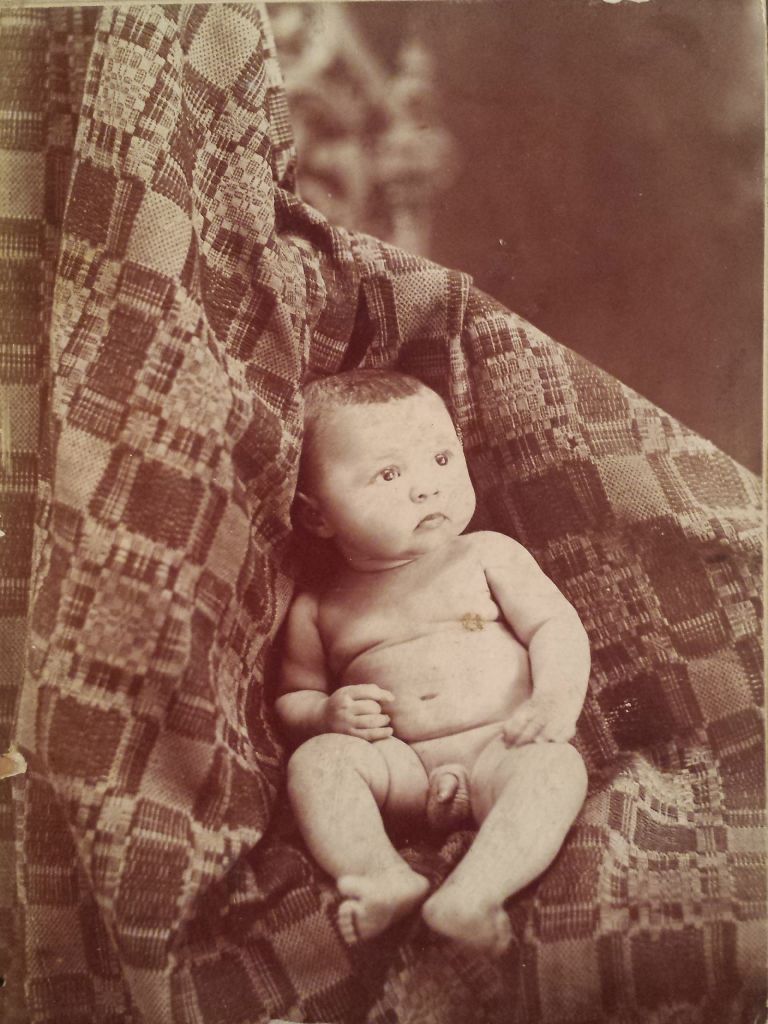


This fella, different from the others, has no jewelry and his baby bits are exposed as opposed to the others who are more covered. 


Although the pendant of the necklace is covered, we can see he is still adorned with one, although no earrings are visible. 
 Another little one with his Crucifix visible.


 This is one of the most peculiar of all the necklaces. It seems to have tentacles. 
I've tried to get as close a look as I can, but all I can make out is... tentacles?


This babe's photo was taken at the same studio as the tentacled necklace baby above. You can see the drapings are the same, with the wicker chair underneath. 
  Again, the necklace is there, but I cannot see the pendant.


This one I tried to make as large as possible, so it may run off the page a bit, but I wanted to be able for you to get a close look at the necklace. A crucifix is present along with another piece I can't identify. Also, earrings again on this one. 


 This little sweetie has drop earrings, maybe a bracelet of some kind, and a necklace that has so far differed from everyone elses. A heart with *possibly* a cross in the middle?


Now, these are our non naked babies, but still unidentified and dazzled up in some jewelery.
 
 This babe, a bit older. Same scruffy fluffy patch of whatever that it... could it be the same studio? Again, drop earrings and necklace, though pendant is hidden. Could it even be the same child, at a later date? Hmm....


This beauty, fully clothed has a large heart pendant. Possibly an older photo of one of the unidentified babies above? I've compared and seen some similarities with one, but I can't, of course, be sure. 


This baby is neither bedazzled nor naked. But nonetheless, still unidentified. 
I didn't want to leave him(her) out.  


  In most instances, these appear to be charms or amulets, some worn as protection from the "Evil Eye" or "Malocchio" The Crucifixes themselves were also worn to ward off evil spirits.
  The photo with the baby that wore the "tentacle" necklace is very likely a chain full of "cuornuciellos"  or little horns worn to protect against the evil eye. The amount of them on the chain makes me think the parents were either being extra protective, or a "test" had been preformed and the infant had been "afflicted" with the Evil Eye.

The Evil Eye, in Greece and Italy, according to Wiki:

Greece

The evil eye, known as μάτι (mati), "eye", as an apotropaic visual device, is known to have been a fixture in Greece dating back to at least the 6th century BC, when it commonly appeared on drinking vessels.[24] In Greece, the evil eye is cast away through the process of xematiasma (ξεμάτιασμα), whereby the "healer" silently recites a secret prayer passed over from an older relative of the opposite sex, usually a grandparent. Such prayers are revealed only under specific circumstances, for according to superstition those who reveal them indiscriminately lose their ability to cast off the evil eye. There are several regional versions of the prayer in question, a common one being: "Holy Virgin, Our Lady, if [insert name of the victim] is suffering of the evil eye, release him/her of it." Evil repeated three times. According to custom, if one is indeed afflicted with the evil eye, both victim and "healer" then start yawning profusely. The "healer" then performs the sign of the cross three times, and emits spitting-like sounds in the air three times. A very similar ritual can be found in neighboring Bulgaria.
Another "test" used to check if the evil eye was cast is that of the oil: under normal conditions, olive oil floats in water, as it is less dense than water. The test of the oil is performed by placing one drop of olive oil in a glass of water, typically holy water. If the drop floats, the test concludes there is no evil eye involved. If the drop sinks, then it is asserted that the evil eye is cast indeed. Another form of the test is to place two drops of olive oil into a glass of water. If the drops remain separated, the test concludes there is no evil eye, but if they merge, there is. There is also a third form where in a plate full of water the "healer" places three or nine drops of oil. If the oil drops become larger and eventually dissolve in the water there is evil eye. If the drops remain separated from water in a form of a small circle there isn't. The first drops are the most important and the number of drops that dissolve in water indicate the strength of the evil eye.
There is another form of the "test" where the "healer" prepares a few cloves by piercing each one with a pin. Then she lights a candle and grabs a pinned clove with a pair of scissors. She then uses it to do the sign of the cross over the afflicted whilst the afflicted is asked to think of a person who may have given him the evil eye. Then the healer holds the clove over the flame. If the clove burns silently, there is no evil eye present; however, if the clove explodes or burns noisily, that means the person in the thoughts of the afflicted is the one who has cast the evil eye. As the clove explodes, the evil eye is released from the afflicted. Cloves that burn with some noise are considered to be λόγια - words - someone foul-mouthing you that you ought to be wary of. The burned cloves are extinguished into a glass of water and are later buried in the garden along with the pins as they are considered to be contaminated. (So be careful if you are ever digging in a Greek garden!) Greek people will also ward off the evil eye by saying φτου να μη σε ματιάξω! which translates to "I spit so that I won't give you the evil eye." The shortened version of this is ftoo, ftoo, ftoo. Contrary to popular belief, the evil eye is not necessarily given by someone wishing you ill, but it stems from admiration. Since it is technically possible to give yourself the evil eye, it is advised to be humble.
The Greek Fathers accepted the traditional belief in the evil eye, but attributed it to the Devil and envy. In Greek theology, the evil eye or vaskania (βασκανία) is considered harmful for the one whose envy inflicts it on others as well as for the sufferer. The Greek Church has an ancient prayer against vaskania from the Megan Hieron Synekdemon (Μέγαν Ιερόν Συνέκδημον) book of prayers.

Italy


Two handsigns (fig sign and horned sign) used in Italy against the evil eye (1914).
The cornicello, "little horn", is also called the cornetto (little horn) or cornetti (plural), is a long, gently twisted horn-shaped amulet. Cornicelli are usually carved out of red coral or made from gold or silver. The type of horn they are intended to copy is not a curled-over sheep horn or goat horn but rather like the twisted horn of an African eland or a chili pepper.[25]
One idea that the ribald suggestions made by sexual symbols distract the witch from the mental effort needed to successfully bestow the curse. Another is that since the effect of the eye was to dry up liquids, the drying of the phallus (resulting in male impotence) would be averted by seeking refuge in the moist female genitals. Among the ancient Romans and their cultural descendants in the Mediterranean nations, those who were not fortified with phallic charms had to make use of sexual gestures to avoid the eye. Such gestures include the fig sign; a fist with the thumb pressed between the index and middle fingers, representing the phallus within the vagina. In addition to the phallic talismans, statues of hands in these gestures, or covered with magical symbols, were carried by the Romans as talismans. In Latin America, carvings of the fist with the thumb pressed between the index and middle fingers continue to be carried as good luck charms.
The wielder of the evil eye, the jettatore, is described as having a striking facial appearance, high arching brows with a stark stare that leaps from his black eyes. He often has a reputation for clandestine involvement with dark powers and is the object of gossip about dealings in magic and other forbidden practices. Successful men having tremendous personal magnetism quickly gain notoriety as jettatori. Pope Pius IV was dreaded for his evil eye, and a whole cycle of stories about the disasters that happened in his wake were current in Rome during the latter decades of the 19th century. Public figures of every type, from poets to gangsters, have had their specialized abilities attributed to the power of their eyes.[26]

https://en.wikipedia.org/wiki/Evil_eye#Greece


If you have looked through the photos and read through the post and find anything to add that would help, or you have your own family experiences in this,  feel free to comment! I would love your input!

Saturday, April 2, 2016

Sepia Saturday: Hee Hawwwwww

http://sepiasaturday.blogspot.com/2016/03/sepia-saturday-324-2-april-2016.html


 I saw the quadruped in the prompt photo and thought, "Oh yes. I got this."

 Because, although MY family has no photos of this sort.... My husband's side has a curious amount. And these aren't burros in Mexico from his Lopez side. They are photos of Italians from Chicago sitting on donkeys or horses. An unusual amount photos. ;) So this was a perfect opportunity to share some!

Let's say hi to Uncle Lou, again! You may recall him from a different Sepia Saturday post "driving" a steer in Hot Springs. In all his posed photos and postcards written home, (and mob ties, cough cough), he seems to be quite the character! He's made me laugh a few times, and I've never even met the guy.


Postcard Worthy: Two Chicago Italians in suits and newsie caps on little donkeys in the thick of Arkansas. 
(Lou is on the right)


The postcard was sent to his sister Jennie, my husband's 2nd great grandmother.  When he gives his regards to "Smooth" I'm going to guess he was referring to her husband, Tony Schavone.


Mr. Tony Schavone. Quite Smooth indeed.....but he isn't riding anything, so I will move on.....

Moving on.......


          Above is another Italian American, Christ McLane (Married to George McLane) in her dress and heels,  who, although is not riding her burro, she is lovingly standing beside it. They clearly enjoy each other. Who doesn't like their ears scratched, right?!


 Obviously not a donkey, but a hoofed cousin, so he counts. This is poor little Peter Schavone, ca 1920's who looks like he would love to enjoy this photo op, but Santa is just a little too creepy....


 See? Absolutely frightening.


 Peter just can't escape! And this time it's not even a horse. It's a deer who just returned from the taxidermist. Poor Peter.


 Ahh, here we go. Peter is a couple years younger here. Maybe he pulled these happier memories of ponies out of his file while in the grips of the creepy santa.... "remember the good times. remember the good times......"
He's so cute, isn't he?


Thanks for stopping by! Hope to see you next Saturday!


Friday, April 1, 2016

Where We Come From: Rosales/Villa Union, Coahuila, Mexico

In continuing with the "Where we come from" series, and after taking a look at some of our German origins, I thought I'd cross to the other side of the tree and find out a bit about where a part of my husband's family comes from:


Rosales and Villa Union, Coahuila, Mexico

     Rosales, or Villa Union as it is called today is in the Mexican state of Coahuila, near the border of the United States.

State of Coahuila in which Rosales resided.

 It is our Lopez name that comes out of Rosales, so I was interested in finding out a little more of its history. I am sure there is so much more than what I have here, but it's a start!

       The first settlement of the area was in the mid 1600's and was a Mission. According to Wiki, the Mission of The Holy Name of Jesus Peyotes to be exact.This mission was small and soon after abandoned. An interesting write up by on the Holy Child of Peyotes can be read here in Spanish, but easily translated with google. (Thank you, Google!)
Iglesia Santo Niño de Peyotes
      The area was left alone until 1737 when another misson (San Francisco de Vizarrón) was formed and inhabited by mostly indigenous people. 2 tribes, the Pausana tribes and Tampajuaya came together to form the Mission of San Francisco de Vizarrón as a more permanent settlement.
      Later, on Valentine's Day, 1868, the town was named Rosales, for a Mexican Field Marshal who fought the Spanish Royals in the Mexican War of Independence, Victor Rosales.   
Victor Rosales
             In 1927, the town of Rosales joined the town of Gigedo, creating what we know now as Villa Union.


 The oldest relatives of Rosales I can locate from my husband's tree (So far) were found on a tree given to me that was previously worked up by I believe a professional. They are the 5th great grandparents of my husband: Francisco Barrera (b 1760) and his wife, Maria Josefa Maña (b 1757), both said to be born in Rosales.  Their daughter, Paula Barrera Maña (b 1784 in Rosales) married Domingo López (b 1780, from unknown place), from whom our Lopez name comes from, and who was of fighting age during the Mexican War for Independence from Spain; down the line to their son Jacinto López Barrera (b. 1802 in Rosales) who came of age during the war; to his son, Domingo López Peña (b. 1830 in Rosales); on to his son Antonio López Ortíz (b. 1873 in Rosales and pictured below on the left) who would have been 37- 47 years old during the next armed struggle Mexico was to participate in, the Mexican Revolution; to his son, Antonio López Antú, (b. 1917 in Rosales), my husband's grandfather, born in the midst of the Revolution. 

Antonio Lopez Ortiz on the left, and his brother Jesus on the right
         I am not aware of who, if anyone, was engaged in any of these historical events, Although I was told by my father in law that the family's purpose for coming to America was to escape Pancho Villa's rise in the north, as their family had sided with the Federal Government. According to him, they lost all of their land and all they had because they had to either flee or face death. And that, my friends, is about as much as I know about the Lopez family and the Mexican Revolution. But I look forward to learning more!

Part of Mexican history and history of Villa Union includes Cabalgatas, or Cavalcades, in which a famous event is honored by a "parade" of people following an historic trail on horseback, or as part of a pilgrimage. I watched one on Youtube coming through Villa Union and it was fascinating! The people and their horses in these Cabalgatas aren't on parade, on show in costume, but rather, participating in something for themselves. Whether it is commemorating an event, or following a pilgrimage, it is about the person and the ride, not something necessarily on show for display. It is simply what it says it is.... a cavalcade. And it would be awesome to be a part of one! Some are small, only passing through town with a few hundred riders while some ride through several towns. Some Cabalgatas can stretch over 100 miles, and can even have over 10,000 riders and horses!


 To the left is a map of Coahuila. I have circled present day Villa Union in blue, and also circled the two most common ports of entrance to the U.S. used by the family based on the border crossing documents I've found. These are Eagle Pass, TX and Laredo, TX.


 I hope to learn much more! So of course, Lopez Family, if you have any information, please leave what you know or what's been passed down to you in oral history in the comments below! It's a great way to communicate with each other over family history!


Want to take a drive through Rosales/VillaUnion today? Why the heck not.... 
Just turn that radio down. ;)


Thursday, March 24, 2016

Where We Come From: Woggersin, Germany and the Boeckenhauer Family's Journey


John (b.6.13.1823) and Sophia (b.12.21.1819)  Boeckenhauer seem to have come from several places in Germany. From Lukas, to Langen, but there was never any proof that tied them to a certain place. Not having found much access or having much finesse locating and deciphering German Documents yet, I still really didn't know where in Germany they had come from.
 
       Which made me excited when I found their ship manifest leaving from Hamburg, and the information THEY themselves gave as where they were from was "Woggersin, Mecklenburg".

AWESOME.   
By Heinz Kippnick; drawn by T. Rystau (de:Benutzer:Ollemarkeagle)This vector image was created with Inkscape.
  Woggersin Coat of Arms


We have our starting point. 

      So, from what I've been able to find, Woggersin is a small village in the "county" of Neverin in the district of Mecklenburgische Seenplatte, in the state of Mecklenburg-Vorpommern in the country of Germany. 

I'll break it down with maps.


There's Germany. ------------>
She's divided into states.
That yellow state on the top right,
That's Mecklenburg-Vorpommern,
with much of it's northern border boasting
coastline on the Baltic Sea.


Mecklenburg-Vorpommern is historically a marriage of Mecklenburg and part of the Prussian province of Western Pomerania. 
       The State of Mecklenburg-Vorpommern seems absolutely beautiful, and you can explore it here.


Now let's go inside MeckPomm....as it's sometimes referred to....
Below is a map of its districts ....


The district of Mecklenburgische Seenplatte is circled in Blue. Inside that district, outlined in red, is the "county" Neverin. and it is inside Neverin,where we find our little municipality of Woggersin, that yellow speck I made near where Neverin splits into two portions.

      Historically speaking, Woggersin is a very old town, with its first mention in written history in the year 1346, and archaeological finds as far back as 8,000 B.C.
   I can't say what it was like in the late 1860's when John and Sophia left, but I gather it was a small community, as today, its population hovers only around 500 people. This is a huge jump from it's population in 1990, which rested at 90 people.

If you take a trip to the official Woggersin Website you can find a wonderful view of the town from above, plus, much more information!


Woggersin from above, courtesy of its municipal website 

 Definitely a small German town, but remarkably, its landscape resembles any farm town here in Illinois and Wisconsin, which I'm sure had a little something to do with why our ancestors chose to settle in these places. :) 

The following photos belong to Ronny Krüger, a kind person who gave me permission to use his own photos of Woggersin found on Panoramio to share with you all to give you a glimpse into Woggersin as it is today.

The Church in Woggersin


 I know what you're thinking.... It looks like Wisconsin, Right?!?
Okay, well, that's what I was thinking. 
And it does.


 Leaving Woggersin

The passage to America had to begin somewhere, triggered by something. Typically economic reasons. John Boeckenhauer was a coach driver, and I can't imagine it was easy finding in employment there at the time.  This was a similar story for many, and it triggered mass emigration from Germany to America during the 1800's. There was an influx of German and Irish immigrants to America in the 1860's, and our Boeckenhauers were a part of this massive movement.


An Ad from the Shipping line the Boeckenhauer family took to America


 If  John Boeckenhauer  saw the advertisement, no one can say, but he and his family crossed the land, 136 miles if it's a straight shot. But a straight shot it wasn't. Just to the east of Woggersin laid difficult terrain they would have to go around, instead of pass through.The journey was likely many more miles. Today, taking a similar route they most likely took, whether to the north or to the south, in a car would take 3-4 hours. They were also traveling in October.With 3 small children. I can't imagine the trek was easy. But, they made it, and on October 25, 1865, My great great grandmother, Sophie Boeckenhauer,(b.6.20.1860) just  5 years, old boarded a ship named Bavaria, of the  Hamburg-Amerikanische Packetfahrt-Actien-Gesellschaf shipping line and left the port of Hamburg with her Parents and her two brothers for America.

The SS Bavaria

The ship was an 8 year old ocean liner of both sail and steam. Their accommodations on the ship were in steerage. The In-between deck, The conditions in steerage were rough and cramped. The deck normally had an average height of 6-8 feet, and wooden bunks, one for each family, ran along both sides of the deck, often two high. The link here shows a typical cross section of what that steerage deck looked like. Conditions were known for being cramped, uncomfortable and often described as atrocious, crowded and smelling awful. 

    From the  U.S. Immigration and Migration Reference Library, 2004 "From U.S. History in Context" I found a passage that gave a mighty clear representation of what emigrating was like at the time for our Boeckenhauers:
     
 
"Although political turbulence and religious repression in Europe triggered small waves of German migration to the United States, most historians note that the mass migrations were mainly motivated by the desire for economic opportunity and prosperity. For many years rural Germans had lived on small family farms. As the German states faced industrialization (the change from a farm-based economy to an economic system based on the manufacturing of goods and distribution of services on an organized and mass-produced basis), the old way of rural life was quickly disappearing. Many were forced to move into cities and learn new skills. Yet, with unemployment in Germany rising, the cities did not always hold much hope. Among those who emigrated, some had few options left in Germany and sought more opportunity. Steady migrations were ongoing starting in the early nineteenth century.
It was a dangerous and difficult trip across the Atlantic. Germans began the journey by making their way to a port city. During the high peaks of emigration there was a steady flow of traffic on the roads to the ports made up of families pushing carts loaded with their belongings. In Germany, most emigrants left from Bremerhaven or Hamburg. Some made their way to Britain in the early eighteenth century, hoping to find passage to North America from there. Others went to Rotterdam, Holland, or Le Havre, France, and sought a ship there. They were often robbed or swindled when they arrived in ports.
The conditions on the sailing ships that took the German immigrants across the Atlantic were terrible. Many people could not afford to purchase a first- or second-class ticket, and so they traveled in steerage, in the lower decks of the ship that were designed to carry cargo. Aside from being miserably overcrowded, the accommodations often lacked clean drinking water and adequate toilet and washing facilities. Rats, head lice, and bedbugs were common, and infectious diseases spread quickly. In the years after, steamships would shorten the voyage and regulations on ships would correct some of the worst abuses of travelers. Even so, throughout the eighteenth and nineteenth centuries, many immigrants faced misery and even death to get to the United States. Despite the hard trip, for over a century Germans immigrated by the hundreds of thousands to the United States."


      YIKES. After traveling such a distance to even get to the port of Hamburg they still had one heck of a trip to endure before they even reached America, where, when they got there, would still not be able to find respite until they reached a little town of Elk Grove, Il. A journey a family took with 3 small children, in less than desirable conditions over 4,362 miles. To make a new start in hopes of a better life. WOW. Just... wow.


So there, in Elk Grove, Illinois, over 4,000 miles later, John Boeckenhauer the Coach Driver became a farmer, and lived a long life with his wife, both of them passing away at the ripe old age of 87. Thanks to the courage of John and Sophie taking such a chance, they hopefully were able to fulfill the wishes they had for themselves and their children, as Americans.

Sophia Boeckenhauer
     
       His daughter, Sophia, a little 5 year old girl at the time of the voyage, grew up a German-American on a farm in Illinois. She went on to have 9 children, including my great grandfather, Henry Wille (b.12.23.1889) and lived the life of a farmer's wife until the age of 96, her husband, Fritz, living until the age of 91. 


     I wonder how it happened that they ended up in Elk Grove Village. I wonder what contacts were made, what rumors of land they may have heard that lead them there. I suppose I will never know, but whatever it was, it was there in that village they lived long and industrious lives, bringing with them those good "Prussian Virtues" from their homeland that undoubtedly made them successful here, in America.


Friday, March 11, 2016

William Henry Burmester's Obituary


I found this today while going through the will and probate records of my 2nd great grandfather, William Henry Burmester,  and the title of his obituary just about took my breath away! Boy, thinking about what a reward that must have been with the Blessed Assurance he most certainly carried with him!

  "William H. Burmester Summoned to Reward"

Hallelujah, Right!?


 "He was genial and courtly in manner, and his word was as good as his bond."


It was a wonderfully written and refreshing obituary to read. Pondering all the things I had read, I realized in that moment so much about my legendary Great Grandmother, Ida Burmester Wille suddenly made so, SO much more sense! 

 William's daughter, Ida Burmester (b. 6.23.1893) was by all accounts a kind, humble, generous, faithful, loving and hard working woman. She passed when I was small, but what I hear most often when we speak of her is "I wish you could have known her like we knew her. She was such a wonderful woman."
After reading William's obituary, it seems the apple did not fall far from the tree with my great grandma, and many of the attributes her own family knew her for could also be found in her father. 
 Now, not to leave her dear mother, Alvina, good woman, of course. But a good GERMAN woman, if you catch my drift. : )  From accounts, and candid photos, she seemed "All work and no play". Like I said... German. Whatever her personality,based on William's description in his obit, I do know it wasn't the likeness shared between William and his daughter, Ida. 
The Burmester Women (My g-grandmother Ida, Aunt Emma, gg-granmother Alvina, and Aunt Mart)

Ida enjoying her great grandchildren


   I can't mention Ida's similarities to her father without mentioning Ida's sister (another daughter of William's) Emma Burmester (b.4.28.1886) who carried on this loving kindness and generosity along the family line. Though Emma never married, she too, cared for all those around her. She took loving care of her mother, Alvina, until her death, and when the depression hit hard, Emma would share her paycheck with her sister Ida, and her family of  10, to help make sure they could make ends meet.

Aunt Emma Burmester, Daughter of William H. Burmester
  It would seem to me that William had set a fine example to those around him. A good and Godly man who lived a life that was loved, and honored. A life that left a great legacy for his children ( All 13 or so!) to draw from.
 Definitely a few more people in my tree I wish 
I could have known personally. <3

 I look forward to going through the rest of the records to see what I find!

Thursday, March 10, 2016

Where We Come From: Intro


 Where We Come From
 

    I want to do a little series of posts here about the origins of our immigrants. Both my husband's and mine. I want us to have a little more knowledge of the land from where we came; The land our grandparents' considered their "native" home. I think this is an important aspect of finding your roots, and one I would like to explore.

     See, the thing about America is that, unless you are Native, You could have come from ANYWHERE in the world. Absolutely anywhere, and relatively recently in history. This is an attribute I find to be very unique and special to the roots of our nation. And even more impressive to me, is that we, cultures from all over the world, HAD to find a way to live together despite our differences. To maintain who they were and become American all at the same time. This sort of journey has about as many routes as there are as many families. Each one of us has a story of how it happened. How it worked, or how it didn't.
   When combining both My husband's and my own families' journeys, for just two people, we have pretty far reaching roots. (as you can see from the graphic I made above, there are a lot of flags represented there.)  I wanted to take a look at the places we came from. So through a couple installments, I hope to give myself, my family and especially my children a better idea of what life was like before their grandparents braved the Atlantic (or the Rio Grande!) to start a new life in an unfamiliar land. And perhaps you, dear reader, who may have stumbled upon these posts and have similar backgrounds, will walk away with a little more knowledge of your ancestor's Native Home, that they no doubt carried with them the rest of their lives.


    I'll be looking back through Northern Sweden, Several areas of Germany, a couple areas of Italy, Greece, a few areas of Norway, possibly Finland, and of course Mexico. Maybe if I am ambitious I can get back to Spain but really, we all know why Spaniards left Spain for Mexico, right? No sense beating a dead horse on that one... And the Irish... I don't know too many specifics on what little, highly diluted Irish we do have so maybe that's something I can develop later on

So I hope you'll keep up with me on these journeys ahead and check back periodically as I compile research and find a way to weave it all together. I look forward to digging into this, and I hope you do too!

  -Dani

Sunday, March 6, 2016

#Genetics


   Finding photos to add to faces is one of the more exciting parts for me, when it comes to my research. I am ALWAYS excited to see family photos.

I've had a little fun lately coming across some photos that have shown the always intriguing power of genetics. 

Sometimes, I open a file that was sent to me and my mouth drops, because my brain thinks it sees someone I already know looking at me from back in time! It's exciting when that happens.

  Last week my cousin sent me a photo in a text, and at first glance I thought it was me. She captioned it "Fornelbow 2.0?"
  ** Backstory.... our great grandmother, Esther wasn't always a woman of many words but when she didn't like something, she let you know with en elbow jab. She was famous for them. Or, possibly, infamous. That (in)famous elbow..... Before she had passed she had remarried a wonderful man, Axel Fornell, and thus became "Esther Fornell". One night, on a drive home from our annual craft fair, they were telling a story of my Uncle who had to sit in the back seat with her once. Anytime he said something she didn't like, most likely some jokes he was cracking... BAM, a curiously strong elderly elbow jab in the ribs. Any time you did something she didn't want, BAM, that sneaky elbow would getcha! 
And in that moment, in a pure stroke of genius, I married the two words, and her infamous elbow jab became forever after, lovingly known as.... The Fornelbow.**

So, this picture, my kids thought it was me. My friends thought it was me. It wasn't me. It was My great grandmother. I took a side by side and posted it. A lot of people thought IT WAS ME. I showed my daughter the photo and asked, "Who is that?" She said, "That's you. How did you do that to the photo? How did you make it that brown color? Can you do that with one of mine?" 
    Now, we aren't identical by any means...but, You can tell it's her genes that came through in me. 
I made a quick snapshot to do a side by side. I wish I had a better comparison, but I think the whole point still comes through with this one. ;)

Me, in my early 30's, and Esther Eugenia Stenman (b. 2.25.1901) in her late teens.


  I more recently came across a photo of  My 3rd great grandfather Joachim Sæther, (b. 6.30.1835) and was able to compare him to a photo from our family that I had confirmed by another person was indeed his daughter, Emma Ingeborg Sæther.(b. 3.19.1866). A great resemblance with their dark set eyes, and nose. But it passed on even farther to my great grandfather, Emma's son, Helge Jonsson   (b. 11.13.1897) I put them side by side, with a younger photo of Helge on the left, and an older one of him on the right. It was fun to compare the resemblances!

L-->R: Young Helge Jonsson, Joachim Sæther, Emme Ingeborg (Sæther) Jonsson, and older Helge Jonsson  
Three generations in one photo, side by side. Father, Daughter, Grandson. How Fascinating!


The next was one we never saw coming. We knew my maternal grandma looked like her dad. I had seen photos, and she definitely favored her dad over her mom. But when a cousin I found online sent me a photo of  my 2nd great grandmother, I thought.... WOW. This genetics thing just hit a whole new level! Haha! 


On the right, Ida Smith
b. 9.5.1856

On the left, Ida's 
grandaughter, 
Mary Jane Smith


Crazy, right? 


I think I find it so fascinating, because it's literally a visual reminder that our ancestors live on through us. The thought itself is a beautiful one and a reminder to stay connected to our past. But when you see the face of someone you've never seen before, who lived 150 years before you were born and you can recognize yourself or your parents in them, everything feels brought to life. These aren't just names, dates and places added to a long list of more names, dates and places. These were lives lived. These are people. These are YOUR people. Their contribution to who you are isn't always just entered as data on a website or written in a file or passed on in a story. Sometimes it's right there, looking you in the  mirror and you never even realized it. Kind of amazing, right?


     I love seeing the resemblances to past generations. If you can find them in your own roots, please feel free to post a link in the comments, because I'd love to stop by and take a look.

- Dani